Inside this note
An unusually old study population makes the 2007 retinol trial by Kafi and colleagues worth examining closely. Thirty-six adults, averaging 87 years of age and living in two senior facilities, participated in a 24-week comparison of retinol lotion with its inactive base. Fine wrinkles improved more on retinol-treated arm skin. That is meaningful evidence about naturally aged skin, but it is not evidence that every retinol product produces the same result—or that a wrinkle score measures resistance to injury.
For Night Routine Notes, the study also illustrates why ingredient, concentration, vehicle, body site, and outcome should remain attached to a research claim. This analysis uses the indexed primary report abstracts for the retinol and comparison trials, alongside the available full official RENOVA labeling. It does not assume access to complete research protocols or supplements. The central task is to distinguish the measured clinical finding from the much smaller biopsy experiments and the broader hypotheses they inspired.
THE NOTE TO KEEP
36 older adults living in two senior facilities; mean age 87 years.
Study facts at a glance
Population: 36 older adults living in two senior facilities; mean age 87 years. Source 3
Controlled comparison: Study personnel applied topical 0.4% retinol lotion and its vehicle to opposite arms, up to three times weekly for 24 weeks. Source 3
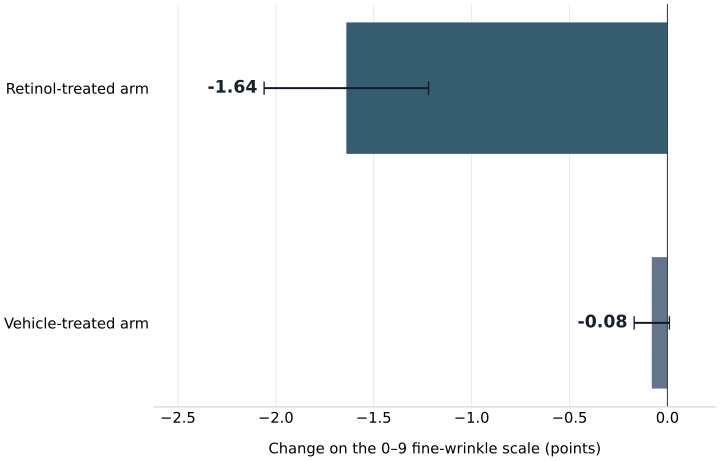
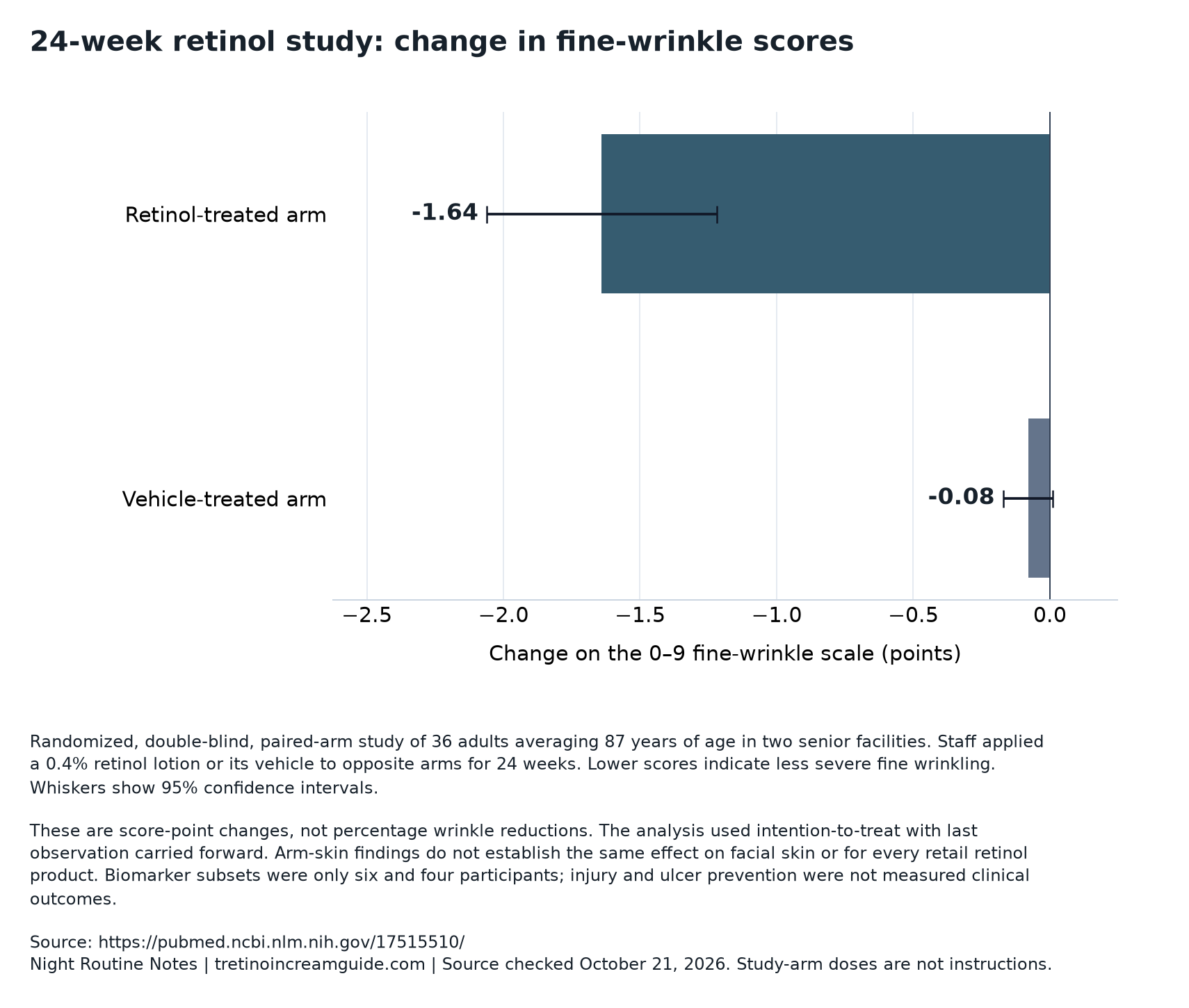
Fine-wrinkle result: Mean score change was −1.64 with retinol versus −0.08 with vehicle on a 0–9 severity scale; the between-treatment comparison had P<.001. Source 3
Biopsy evidence: Glycosaminoglycan expression was assessed in a subgroup of six; procollagen I immunostaining in a subgroup of four—not all 36 participants. Source 3
Safety boundary: The indexed retinol abstract does not provide complete adverse-event counts. RENOVA safety figures concern a different ingredient and an exact prescription cream. Source 3 Source 1
Why naturally aged arm skin was the question
The retinol trial addressed clinical signs of natural aging, rather than recruiting a population defined by moderate or severe facial sun damage. Its participants were residents of two senior citizen facilities, and their mean age was 87. A mean describes the group’s center; it does not establish that everyone was 87 or reveal the age range. The indexed abstract does not provide enough demographic detail to reconstruct how representative the group was.
That distinction matters when interpreting the result. An arm-skin experiment in very old adults is unusually direct evidence for that setting, yet it does not estimate the response of younger facial skin. Nor does the description of naturally aged skin establish that participants had no lifetime sun exposure. It identifies the study’s clinical focus, not a perfectly isolated biological cause of every wrinkle.
The body site also belongs in the headline claim. The researchers observed treated arm areas, not whole-face appearance or a person’s overall impression of looking younger. A useful reading therefore starts with a narrow question: did this particular retinol intervention improve the assessed fine wrinkling of these arm sites over 24 weeks?
Read the underlying chart data: download CSV or download the source-labeled chart.
Opposite arms created a strong local comparison
The study was randomized, double-blind, and vehicle-controlled, using a left-versus-right arm comparison. Each person contributed skin exposed to retinol and skin exposed to the lotion base without retinol. This within-person design reduces the influence of differences between people: age, general health, and many lifetime exposures are shared by the two treatment sites.
Random allocation helps prevent systematic assignment of the active treatment to one side. Blinding is intended to reduce expectations influencing treatment delivery or assessments. The abstract identifies these design features but does not explain the randomization sequence, who held the treatment code, or whether investigators tested how well blinding worked. Those details should remain unknown rather than being filled in from assumptions about standard practice.
The comparator was not untreated skin. A vehicle can itself influence skin appearance through the properties of its base. Comparing retinol with that vehicle asks what the active-containing preparation adds beyond the base under trial conditions. Also, 36 participants with paired arms are not 72 independent participants: observations from one person are related.
The intervention was a lotion delivered by study staff
The active intervention was topical 0.4% retinol lotion, applied by study personnel at visits up to three times a week for 24 weeks. Those details identify the experimental exposure, not a recommended home routine. In particular, up to three applications weekly does not establish that every participant received exactly the same number of applications throughout follow-up.
Staff application is important because it places delivery inside the study rather than leaving it entirely to participants’ self-reported use. Even so, the abstract does not give a complete application log, amount per application, or full ingredient list. It therefore cannot show that a retail product with the same percentage reproduces the tested formulation and exposure.
Retinol is not tretinoin, which is retinoic acid. Their percentages cannot be placed on a single potency ladder merely by comparing the numbers printed on containers. Our tretinoin-versus-retinol guide provides context for keeping those ingredient identities separate. Here, the evidence remains attached to one retinol lotion, not to prescription tretinoin cream or the entire over-the-counter retinol category.
Reading the wrinkle score without turning it into a percentage
The clinical assessment used a semiquantitative severity scale running from 0, meaning none, to 9, meaning most severe. Semiquantitative means that an observer assigns an ordered score rather than measuring wrinkle depth in a physical unit such as millimeters. Lower scores represent less severe wrinkling. The main reported clinical result was the change in fine-wrinkle score after 24 weeks.
Retinol-treated skin changed by −1.64 points, with a 95% confidence interval from −2.06 to −1.22. Vehicle-treated skin changed by −0.08 points, with a 95% confidence interval from −0.17 to 0.01. Subtracting the reported changes gives a descriptive difference of 1.56 scale points favoring retinol. The abstract does not supply a confidence interval for that paired difference.
This is not a 64% wrinkle reduction. The digits in 1.64 describe points on an assessment scale, not a percentage. Nor does the result say that every participant improved by that amount. Without individual response distributions, baseline scores, or a stated threshold for a personally meaningful change, the average cannot tell us how many people noticed a substantial visible benefit.
What the reported 24-week fine-wrinkle numbers mean
| Measure | Reported result | Interpretation |
|---|---|---|
| Retinol score change | −1.64; 95% CI −2.06 to −1.22 | Average improvement on the 0–9 scale; not a percent reduction. |
| Vehicle score change | −0.08; 95% CI −0.17 to 0.01 | Little average change; the interval includes zero. |
| Between-treatment test | P<.001 | Evidence of a treatment difference, not its practical importance for each person. |
| Difference calculated from reported changes | 1.56 points favoring retinol | Descriptive subtraction; no confidence interval for this difference is reported in the abstract. |
Statistical confidence does not resolve missing observations
The reported P<.001 supports a difference between treatments under the statistical analysis used. It is not the probability that retinol works for a particular person, and it does not establish the size of an effect on a different body site. The confidence intervals convey uncertainty around the estimated changes, but they too depend on the study’s measurements and analysis.
The investigators described an intent-to-treat analysis using last observation carried forward. Intent-to-treat generally aims to preserve the randomized comparison. Last observation carried forward fills a missing later measurement with that participant’s most recent available measurement. It is an analysis method, not evidence that everyone completed every visit or that there was no attrition.
For illustration, if an earlier wrinkle score were substituted for a missing 24-week score, the analysis would treat that earlier condition as unchanged at the later assessment. Depending on what actually happened afterward, that could overstate or understate the final response. The abstract does not report enough missing-data detail or sensitivity analyses to determine how strongly this choice affected the result.
The biopsy findings were smaller, separate experiments
Biopsies offered a possible biological explanation for the clinical finding, but they did not involve the full study population for each reported measure. Increased glycosaminoglycan expression was reported in six participants, with P=.02. Increased procollagen I immunostaining was reported in four, with P=.049. The abstract does not establish how those subgroups were selected or whether they overlapped.
Glycosaminoglycans are components of the skin’s surrounding matrix that can retain water. Procollagen is a precursor involved in collagen production; immunostaining uses antibodies to detect a tissue signal. These measures are relevant to skin structure, but a stronger staining signal is not equivalent to a measured percentage increase in mature collagen or a direct test of mechanical strength.
The indexed report gives P-values, not quantitative effect estimates and confidence intervals for these biopsy outcomes. Consequently, we cannot say how large or precise the tissue changes were. Their direction is consistent with the authors’ proposed explanation for smoother appearance, but small subgroup findings do not establish that the same biological response occurred in every participant or caused the observed clinical improvement.
Better-looking skin was not a test of ulcer prevention
The investigators proposed that greater skin-matrix synthesis might make aged skin more resistant to injury and ulcer formation. That is a hypothesis extending from the tissue findings, not a reported clinical prevention result. The indexed report does not present counts of skin tears, new ulcers, wound-healing times, or injury-related hospital care.
The distinction is more than wording. Wrinkle ratings describe appearance, biochemical markers describe selected tissue processes, and ulcer prevention describes a clinical event with multiple possible causes. To establish protection against injury, a study would need to measure that outcome directly with suitable follow-up and a defined comparison. Improvement in one domain does not automatically validate another.
Even the proposed mechanism contains unresolved steps: whether marker changes yield more functional matrix, whether that matrix changes tissue strength, and whether any strength difference reduces injuries in daily life. The retinol trial offers a reason to investigate those questions. It does not answer them, and it should not be presented as evidence for treating wounds or preventing pressure injuries.
Tretinoin trials add context, not a conversion formula
A separate 48-week double-blind study reported 99 completers using facial tretinoin cream at 0.1%, 0.025%, or vehicle once daily. Both active concentrations improved photoaging compared with vehicle, without a clinically or statistically significant efficacy difference between them. The higher concentration caused significantly more erythema and scaling—redness and flaking. Our close reading of that concentration trial examines that separation between improvement and irritation.
Another randomized trial treated 204 subjects with 0.05% tretinoin emollient cream or vehicle on the face for up to two years. It reported greater improvement in several clinical signs of photodamage and increased procollagen-synthesis marker staining at month 12. The abstract does not provide numerical clinical effect sizes or confidence intervals that would support a magnitude comparison with the retinol trial.
These are different drugs, vehicles, anatomical sites, populations, schedules, and follow-up periods. Putting them side by side helps identify the questions each study addressed; it does not rank retinol against tretinoin. Neither longer follow-up nor a larger concentration number creates an equivalence rule between a retinol lotion and a tretinoin cream.
Three studies with different questions—not a head-to-head ranking
| Study setting | Intervention and follow-up | Main interpretive contribution |
|---|---|---|
| 36 older adults; naturally aged arm skin | 0.4% retinol lotion versus vehicle; 24 weeks | Paired-arm fine-wrinkle improvement, with very small biopsy subgroups. |
| 99 completers; facial photoaging | 0.1% or 0.025% tretinoin cream versus vehicle; 48 weeks | Similar reported efficacy between concentrations, but more irritation with 0.1%. |
| 204 subjects; moderate to severe facial photodamage | 0.05% tretinoin emollient cream versus vehicle; up to two years | Longer-term clinical and histologic observations for that preparation. |
Safety evidence must stay with the product studied
The retinol abstract does not provide a complete adverse-event tally, irritation rates, or reasons for withdrawal. That absence prevents a reliable numerical account of tolerability in these very old participants. It is not evidence of zero irritation. Similarly, the two-year tretinoin trial’s finding of no increase in certain adverse histologic changes is narrower than a claim that users experienced no troublesome local reactions.
Official RENOVA 0.02% labeling supplies concrete safety information for that exact tretinoin cream. Almost all treated patients in the described studies reported at least one local reaction. The label reports 32% in a combined category involving severe irritation, temporary discontinuation, or use of a mild topical corticosteroid; about 4% discontinued because of adverse reactions. These figures cannot be assigned to the retinol lotion.
The label also addresses sun sensitivity and pregnancy restrictions. Its geriatric discussion concerns ages 65–71 and states that safety and effectiveness above 71 have not been established. The retinol participants’ mean age of 87 does not fill that product-specific gap. Our irritation guide and clinician-centered night-routine guide address practical discussions without turning this research schedule into personal instructions.
Why a formulation record is more useful than a borrowed claim
RENOVA 0.02% is a specified oil-in-water tretinoin cream with an official ingredient record and a narrow labeled role: mitigation of fine facial wrinkles alongside comprehensive skin care and sunlight avoidance. That is not the same intervention as 0.4% retinol lotion. The label also cautions that relationships between procollagen staining and clinical effects have not been clearly defined, reinforcing the distinction between a tissue marker and a visible outcome.
Editorial interpretation: when assessing a product or service, a useful documentary question is whether the exact active ingredient, strength, base, and intended use are identifiable. A research citation beside an offer does not establish that its formulation matches the trial. Our cream-cost guide considers the separate financial questions; none of these studies measured prices, subscription value, or service quality.
For contract documentation, the Alloy review and CoreAge Rx review can help readers check stated offer terms. Those links do not imply access to the studied lotion or equivalent clinical outcomes. The trial abstracts do not identify sponsors, so funding cannot be characterized from them; RENOVA’s label names Bausch Health, but that does not establish sponsorship of the separate studies.
Source 3 Source 2 Source 4 Source 1
Questions about the evidence
Does this study show that retinol works even at very old ages?
It supports improvement in assessed fine arm wrinkles in one group of 36 adults whose mean age was 87, using one staff-applied lotion for 24 weeks. That is direct evidence in a notably old population. It does not establish equal benefit across all older adults, all skin types, facial sites, or commercial retinol preparations.
Was the wrinkle reduction 64%?
No. The reported retinol change was −1.64 points on a 0–9 severity scale. A scale-point change is not a percentage reduction. The vehicle change was −0.08 points, leaving a descriptive 1.56-point difference between the reported changes. The abstract does not provide the information needed to translate that into a percentage of wrinkles removed.
Did every participant have increased collagen?
That was not demonstrated. Procollagen I immunostaining was reported in a subgroup of four participants, and it measures a precursor-related tissue signal rather than total mature collagen. The abstract provides a P-value but no percentage increase or confidence interval for the amount of change. The finding should not be expanded to all 36 participants.
Does 0.4% retinol correspond to a particular tretinoin strength?
These studies establish no conversion. Retinol and tretinoin are different ingredients, and the trials used different vehicles, sites, populations, schedules, and follow-up periods. A numerical comparison of label percentages cannot establish matching efficacy or irritation. A direct comparative study would be needed to address a specific equivalence claim.
Does the study justify using retinol to prevent skin ulcers?
No clinical ulcer-prevention result is reported. The authors suggested greater resistance to injury based on matrix-related findings, but the indexed report does not supply ulcer incidence, skin-tear rates, or healing outcomes. That proposal remains a research hypothesis, distinct from the observed improvement in fine-wrinkle scores.
What this evidence supports
The clearest result is a controlled, 24-week improvement in fine-wrinkle scores on naturally aged arm skin with one 0.4% retinol lotion. The paired design strengthens the local comparison, while the small population and missing-data method limit certainty about its breadth and exact magnitude. Biopsy findings add biological plausibility, not proof of injury prevention. For a cream-focused research companion, the lasting lesson is precision: preserve the ingredient, vehicle, population, site, and measured outcome rather than letting a persuasive study become a universal product claim.
Research access and limitations
This analysis uses indexed original-research abstracts for the three trials and full official RENOVA labeling. The abstracts do not provide complete protocols, participant characteristics, funding disclosures, application records, or comprehensive adverse-event tables. No head-to-head retinol–tretinoin comparison is available in this evidence set.
CHECK THE ORIGINALS
Sources for this note
Individual source check dates appear below. Commercial pages describe the seller’s offer; clinical sources have their own evidence limits.
- DailyMed — RENOVA tretinoin cream 0.02% label ↗
Label updated February 24, 2026. The fine-wrinkle indication is product specific, adjunctive to comprehensive skincare and sun avoidance. Checked 2026-10-21.
- Two concentrations of topical tretinoin (retinoic acid) cause similar improvement of photoaging but different degrees of irritation. A double-blind, vehicle-controlled comparison of 0.1% and 0.025% tretinoin creams. ↗
Indexed original research abstract Checked 2026-10-21.
- Improvement of naturally aged skin with vitamin A (retinol). ↗
Indexed original research abstract Checked 2026-10-21.
- Long-term efficacy and safety of tretinoin emollient cream 0.05% in the treatment of photodamaged facial skin: a two-year, randomized, placebo-controlled trial. ↗
Indexed original research abstract Checked 2026-10-21.