Inside this note
A stronger tretinoin cream contains more active ingredient, but that does not establish how much additional visible benefit it will deliver. A 48-week comparison published in 1995 offers a particularly useful test of that assumption. Two topical cream concentrations produced similar observed clinical improvement in facial photoaging, while the higher concentration caused more redness and scaling.
For Night Routine Notes, the important distinction is between concentration, formulation, visible changes, and changes measured in skin samples. These are related questions, not interchangeable outcomes. This analysis uses the indexed primary research abstracts and the available official RENOVA labeling; it does not assume access to the studies’ full protocols or supplements. Together, those records support a careful explanation of the trial—not a universal rule for selecting a prescription strength.
THE NOTE TO KEEP
The 1995 report describes 99 completers over 48 weeks, not a confirmed starting enrollment of 99.
Study facts at a glance
Study population: The 1995 report describes 99 completers over 48 weeks, not a confirmed starting enrollment of 99. Source 2
Historical study arms: Completers used topical 0.1% tretinoin cream (32), 0.025% cream (35), or vehicle cream (32), once daily. Source 2
Clinical comparison: Both concentrations improved facial photoaging versus vehicle; no clinically or statistically significant efficacy difference between concentrations was reported. Source 2
Irritation finding: Redness and scaling were significantly greater with 0.1% than with 0.025% tretinoin. Source 2
Formulation boundary: RENOVA 0.02% has a specific fine-facial-wrinkle indication and its own formulation and safety record; it is not one of the 1995 study arms. Source 1 Source 2
What the 48-week study compared
The 1995 study examined photoaged skin—skin changes associated with accumulated sunlight exposure. It compared two topical tretinoin creams with their vehicle, the cream base without active tretinoin. Treatment was once daily for 48 weeks in a double-blind design, meaning treatment identity was intended to remain concealed during the comparison. Those exposures describe historical research arms, not instructions for a current routine.
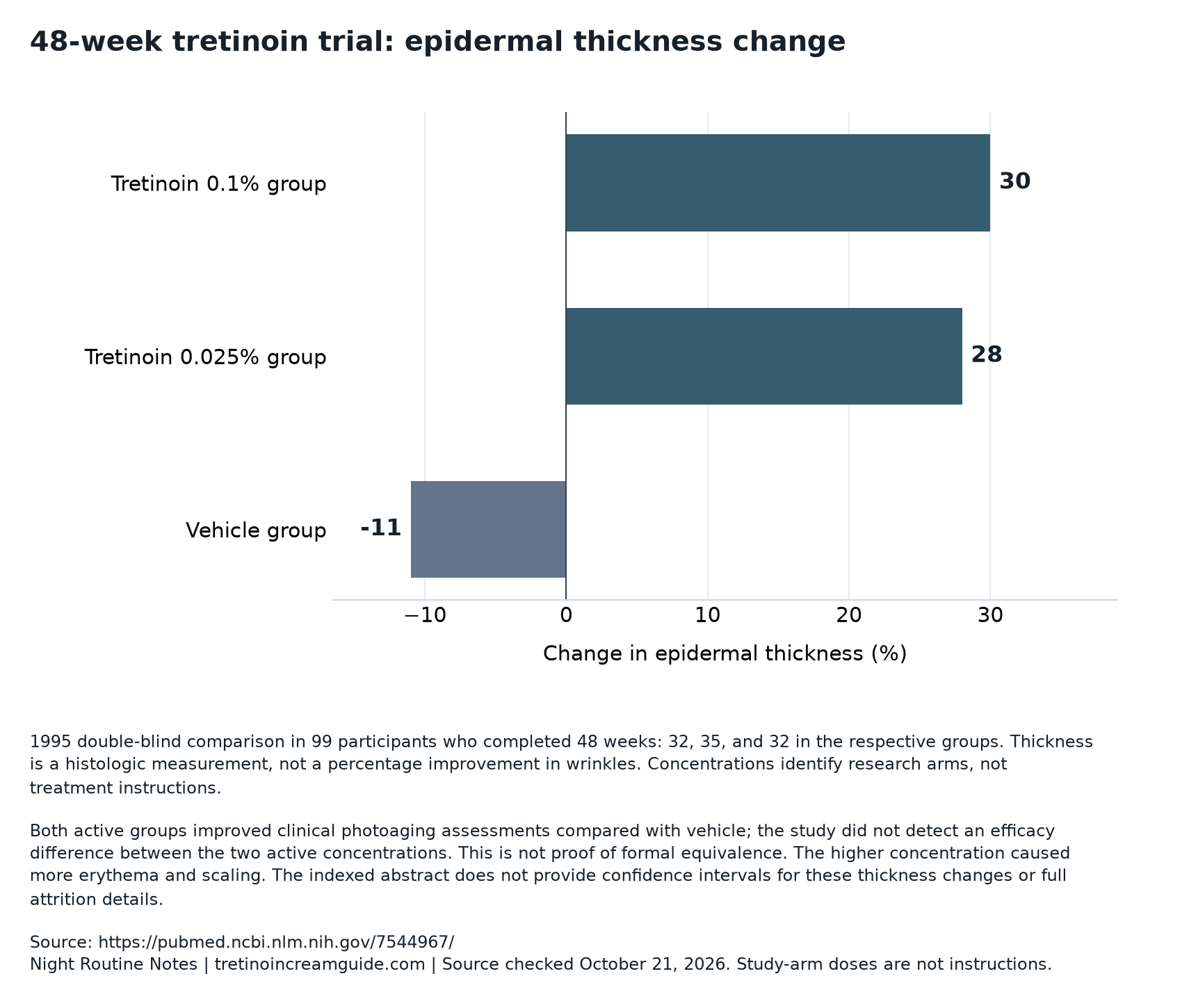
Among the 99 people who completed the study, 32 used 0.1% tretinoin, 35 used 0.025%, and 32 used vehicle. The indexed abstract does not give the original enrollment denominator, allocation procedure, or treatment-specific withdrawals. Calling this a trial of 99 randomized participants would therefore add information that the accessible record does not establish.
Investigators assessed clinical photoaging alongside skin-sample findings before and after treatment. Those measurements included epidermal thickness, vascularity, and several immune-system markers. The abstract does not identify one prespecified primary endpoint or provide the clinical scoring instrument. Its breadth helps distinguish visible effects from tissue effects, but leaves important details about outcome prioritization unresolved.
Read the underlying chart data: download CSV or download the source-labeled chart.
Similar observed benefit is not proof of equivalence
Both tretinoin concentrations produced statistically significant overall improvement in facial photoaging compared with vehicle. Between the two active creams, the investigators reported no clinically or statistically significant difference in efficacy. That supports a narrow but useful conclusion: this study did not demonstrate an added clinical advantage for 0.1% over 0.025% under the conditions examined.
It does not prove that the concentrations are interchangeable. A formal equivalence or noninferiority trial requires a predefined margin specifying how much difference would count as acceptably small, plus an analysis capable of testing that margin. The abstract reports neither. A nonsignificant comparison can reflect genuinely close effects, limited precision, or both.
The accessible report also supplies no clinical effect sizes or confidence intervals for the concentration comparison. Readers cannot calculate how large a missed advantage might have been or how many participants achieved a specified visible response. Nor does the 48-week result establish identical speed of improvement earlier in treatment. The finding challenges automatic strength escalation without settling every concentration question.
Reading the biopsy percentages correctly
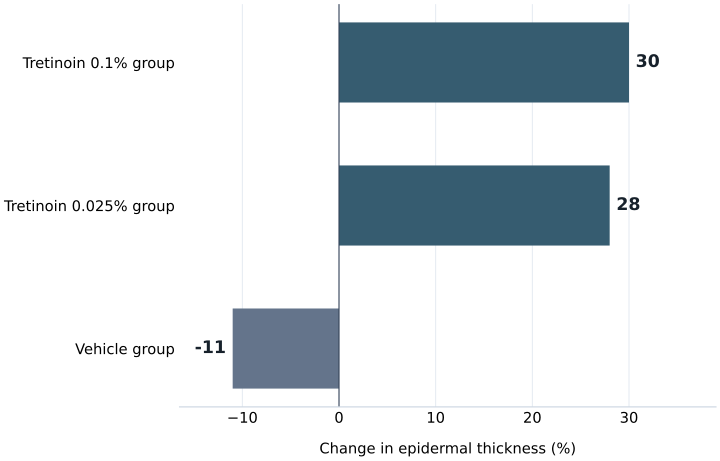
Histology means examining tissue microscopically. At 48 weeks, epidermal thickness increased by 30% with 0.1% tretinoin and 28% with 0.025%, while the vehicle group showed an 11% decrease. These are changes in a tissue measurement, not percentages of wrinkles removed or percentages of people satisfied with their appearance.
Vascularity was measured using dermal endothelial cell area, a measure related to the cells lining blood vessels. It increased by 100% and 89% in the respective tretinoin groups, versus a 9% decrease with vehicle. A 100% increase means that measured quantity doubled relative to baseline; it does not mean the skin became completely repaired or twice as youthful.
As a worked interpretation, the 30% and 28% thickness changes differ by 2 percentage points. That arithmetic describes the reported measurements, not a 2-percentage-point difference in cosmetic success. Baseline absolute measurements and confidence intervals are absent from the abstract, so these percentages cannot establish the exact size or precision of tissue differences between concentrations.
The 1995 tissue results are measurement changes, not wrinkle-response rates.
| Measurement at 48 weeks | Reported change by study arm | What the number describes |
|---|---|---|
| Epidermal thickness | 0.1%: +30%; 0.025%: +28%; vehicle: −11% | Change in the measured thickness of the epidermis |
| Dermal vascularity | 0.1%: +100%; 0.025%: +89%; vehicle: −9% | Change measured through dermal endothelial cell area |
| Overall facial photoaging | Both active creams improved versus vehicle; no numerical clinical effect size in the abstract | Clinical assessment, separate from the tissue percentages |
| Redness and scaling | Greater with 0.1% than 0.025%; absolute rates not given | Irritant effects, not evidence of greater cosmetic benefit |
More irritation did not track with more improvement
The higher concentration produced significantly more erythema, meaning redness, and scaling. The abstract describes this finding across various analyses, but does not provide absolute rates, severity distributions, or irritation-related withdrawal counts. Consequently, the study supports a direction of difference without showing how often a particular person might experience troublesome irritation.
The scientific interest lies in the separation: the clinical and histologic improvements were similar despite greater irritation with 0.1%. If extra irritation were the main driver of extra benefit, a corresponding efficacy advantage might have been expected. The authors interpreted the pattern as suggesting that mechanisms other than irritation dominate tretinoin-associated improvement in photoaged skin.
That is a mechanistic inference, not proof that irritation contributes nothing or that improvement never accompanies irritation. The study did not independently manipulate irritation while holding every other treatment property constant. For practical symptom language, the tretinoin irritation guide provides a separate framework; redness or peeling should not be treated as a score showing how well a cream is working.
The immune measurements answer a narrower question
The researchers also investigated whether prolonged topical treatment altered selected components of the skin’s immune system. They assessed keratinocyte expression of HLA-DR and intercellular adhesion molecule-1, along with epidermal Langerhans cells and epidermal and dermal T lymphocytes. These are cellular markers and immune-cell populations, not direct measures of infection resistance.
No significant changes were reported when tretinoin and vehicle treatments were compared for these markers. This adds information beyond cosmetic grading: the measured improvements did not coincide with a detected treatment difference in the particular immune features examined. It does not establish that every aspect of cutaneous immunity remained unchanged.
The missing starting denominator matters here as well as for efficacy. If withdrawals occurred, knowing their distribution and reasons would help assess whether the completer findings represent everyone who began treatment. Without that information or confidence intervals, the abstract cannot distinguish tightly estimated null effects from less precise results. Neither sponsorship nor funding is identified in the accessible abstract.
What the two-year 0.05% study adds
A separate 2005 randomized, placebo-controlled study examined topical tretinoin emollient cream 0.05% in 204 subjects with moderate to severe facial photodamage. The active cream or vehicle emollient cream was applied to the entire face once daily for up to two years, with clinical and histologic assessments at scheduled visits. This extends observation time, but does not extend the 1995 concentration comparison.
The abstract reports significantly greater improvement with tretinoin in fine and coarse wrinkling, mottled hyperpigmentation, lentigines, sallowness, overall photodamage severity, and the investigator’s global assessment. It provides no numerical endpoint changes or confidence intervals. The magnitude of benefit therefore cannot be reconstructed, and 0.05% cannot be ranked between the earlier concentrations using these reports.
Histology showed no increase versus vehicle in keratinocytic or melanocytic atypia, dermal elastosis, or adverse effects on the stratum corneum. Procollagen 1C terminal staining, a marker of procollagen synthesis, increased at month 12 in testing conducted at three centers. These findings describe selected tissue outcomes; they are not proof of cancer prevention, improved survival, or absence of all adverse effects. The abstract does not enumerate local adverse-event rates or identify funding.
Why the retinol arm study is a different experiment
The 2007 retinol trial studied 36 elderly adults, averaging 87 years old, living in two senior facilities. In a randomized, double-blind, left-versus-right arm comparison, study personnel applied 0.4% retinol lotion or vehicle up to three times weekly for 24 weeks. Ingredient, vehicle, application site, population, and exposure schedule all differed from the tretinoin study.
On a 0–9 severity scale, mean fine-wrinkle score changes were −1.64 with retinol, with a 95% confidence interval of −2.06 to −1.22, and −0.08 with vehicle, with an interval of −0.17 to 0.01. Subtracting the reported changes gives a descriptive 1.56-point greater reduction with retinol. That is a scale-point contrast, not a percentage improvement; the abstract does not provide a confidence interval for that subtraction.
The analysis used intent-to-treat methods with the last observation carried forward for missing later measurements. Biochemical findings came from much smaller subgroups: six for glycosaminoglycan expression and four for procollagen I staining. The 24-week retinol study analysis explores those boundaries, while the tretinoin-versus-retinol guide explains why ingredient percentages cannot serve as a shared potency scale.
Three trials answer different questions rather than forming a concentration ladder.
| Study | Population and comparison | Distinct contribution |
|---|---|---|
| 1995 tretinoin concentration study | 99 completers; facial photoaging; 0.1%, 0.025%, and vehicle creams; 48 weeks | Direct comparison of two concentrations, including irritation and histology |
| 2005 tretinoin emollient-cream study | 204 subjects; moderate to severe facial photodamage; 0.05% versus vehicle; up to two years | Longer clinical and tissue observation, not a strength comparison |
| 2007 retinol lotion study | 36 elderly adults; opposite-arm retinol and vehicle comparison; 24 weeks | Evidence for a different ingredient on naturally aged arm skin |
RENOVA 0.02% has a formulation-specific indication
The official RENOVA label describes 0.02% tretinoin in a specified oil-in-water emulsion. Its indication is adjunctive mitigation of fine facial wrinkles in people using comprehensive skin care and sunlight avoidance. That is narrower than universal approval for reversing aging. The label explicitly does not claim wrinkle elimination, repair of sun-damaged skin, or restoration of younger skin.
The label summarizes five controlled 24-week trials involving 324 evaluable active-treatment patients and 332 evaluable vehicle patients. Two trials adequately demonstrated efficacy for fine facial wrinkles. The same threshold of replicated demonstration was not met for coarse wrinkling, mottled hyperpigmentation, tactile roughness, or laxity. Both active and vehicle groups also received comprehensive skin protection, which matters when interpreting the comparator.
This 0.02% formulation is neither the 0.025% nor the 0.1% cream from 1995. The label also states that no studies compared its irritation or efficacy with the older RENOVA 0.05% formulation. Accordingly, the cream comparison guide is best used to organize product documentation, not to translate separate trials into a universal ranking. Bausch Health is identified as RENOVA’s distributor, not thereby established as sponsor of the historical studies.
Lower concentration does not mean irritation-free
RENOVA’s safety data show why the 1995 finding should not become a promise that lower-strength creams are gentle for everyone. In controlled studies involving 339 active-treatment patients, almost all reported at least one local reaction, including peeling, dryness, burning, stinging, redness, or itching. About 4% discontinued because of adverse reactions.
The label’s 32% irritation figure combines several possibilities: irritation rated severe, irritation leading to temporary discontinuation, or irritation leading to mild topical corticosteroid use. It should not be rewritten as 32% having severe irritation. About 7% of active-treatment patients, versus less than 1% of controls, required short-term mild topical corticosteroids for local irritation. These are RENOVA findings, not rates from the 1995 creams.
The label also addresses heightened sunburn susceptibility, photosensitizing medicines, hypersensitivity, and pregnancy restrictions. Its safety and efficacy beyond 52 weeks are not established for this exact product; the separate two-year 0.05% study does not erase that boundary. The pregnancy-planning guide offers context for a clinician discussion without treating a historical trial as current prescribing information.
Why a formulation record belongs beside the strength
The evidence supports recording more than a percentage: active ingredient, concentration, cream or other vehicle, manufacturer or dispensing formulation, indication, and applicable labeling. The 1995 abstract identifies cream concentrations but does not supply a complete ingredient record. That missing detail limits attempts to match its outcomes to a present-day product, particularly one with additional active ingredients.
Editorial interpretation: a stronger concentration alone is not evidence of greater value, and a lower advertised price is not evidence of equivalent treatment. Research on a specified topical cream does not automatically validate a compounded formula, a different route, or a provider’s clinical outcomes. The study also supplies no costs or contract comparisons from which to estimate financial benefit.
For documentary review only, the CoreAge Rx review and Alloy review can help readers inspect formula descriptions and offer terms. Those links do not establish that either provider supplies a studied formulation or reproduces trial results. The unresolved scientific question remains more specific: which well-characterized formulations deliver meaningful clinical improvement with acceptable irritation across different populations and longer follow-up?
Questions about the evidence
Did the trial show that 0.025% tretinoin works just as well as 0.1%?
It found similar observed clinical improvement and no significant efficacy difference over 48 weeks. That is not formal proof of equivalence. Without a predefined equivalence margin and confidence intervals for the comparison, the accessible abstract cannot establish how much difference was reliably excluded.
Does a 30% increase in epidermal thickness mean 30% fewer wrinkles?
No. Epidermal thickness is a tissue measurement; wrinkle improvement is a clinical outcome. Their units and meanings differ. The study assessed both, but the abstract does not provide a conversion between them or a numerical percentage reduction in wrinkles.
Does peeling show that tretinoin is producing more benefit?
Not in this comparison. The 0.1% cream caused more redness and scaling without a demonstrated additional clinical benefit. That separation argues against using irritation as a benefit meter, although it does not prove that irritation has no role in any treatment response.
Can the two-year study establish long-term safety for every tretinoin cream?
No. It contributes two-year evidence for a particular 0.05% emollient cream and selected clinical and histologic outcomes. Its abstract does not enumerate every adverse effect. Different formulations retain their own evidence boundaries, including RENOVA 0.02% labeling that does not establish daily safety and efficacy beyond 52 weeks.
Why not compare 0.4% retinol directly with 0.025% tretinoin?
The percentages describe different ingredients, not equivalent biological exposures. The retinol trial also used lotion on elderly adults’ arms for 24 weeks, whereas the tretinoin comparison concerned facial photoaging over 48 weeks. Without a head-to-head study, those findings cannot establish which ingredient or product performs better.
What this evidence supports
The 1995 comparison provides a meaningful challenge to the assumption that more concentrated tretinoin cream necessarily produces better photoaging results. Its strongest finding is the combination of similar observed clinical and tissue improvements with greater irritation at 0.1%. Its principal weaknesses are the incomplete enrollment and withdrawal record in the abstract, absent numerical clinical effect sizes, and lack of formal equivalence testing. Longer-term tretinoin research and the retinol arm study add distinct evidence, not interchangeable confirmations. For cream-specific interpretation, concentration should remain attached to formulation, population, comparator, outcome, and follow-up.
Research access and limitations
This analysis uses three indexed original research abstracts and the official RENOVA label available in full. Full study protocols, supplements, detailed adverse-event tables, and funding disclosures were not available in the abstracts. Missing estimates and confidence intervals have not been reconstructed.
CHECK THE ORIGINALS
Sources for this note
Individual source check dates appear below. Commercial pages describe the seller’s offer; clinical sources have their own evidence limits.
- DailyMed — RENOVA tretinoin cream 0.02% label ↗
Label updated February 24, 2026. The fine-wrinkle indication is product specific, adjunctive to comprehensive skincare and sun avoidance. Checked 2026-10-21.
- Two concentrations of topical tretinoin (retinoic acid) cause similar improvement of photoaging but different degrees of irritation. A double-blind, vehicle-controlled comparison of 0.1% and 0.025% tretinoin creams. ↗
Indexed original research abstract Checked 2026-10-21.
- Improvement of naturally aged skin with vitamin A (retinol). ↗
Indexed original research abstract Checked 2026-10-21.
- Long-term efficacy and safety of tretinoin emollient cream 0.05% in the treatment of photodamaged facial skin: a two-year, randomized, placebo-controlled trial. ↗
Indexed original research abstract Checked 2026-10-21.